







The tungsten signal: the war premium left oil for a metal nobody tracks
Oil is falling on peace talks while a strategic metal almost nobody follows has risen tenfold since 2022. This is where the durable war premium has gone, and why it matters.
This week gave us two prices moving in opposite directions, and the contrast is the whole story.
The first is the one everyone quotes. Brent crude, the global oil benchmark, fell below USD 80 a barrel for the first time since the Iran war reignited, dropping about 5 % in a single session as talks between Washington and Tehran raised hopes that tankers could move freely through the Strait of Hormuz again. The Strait is the narrow sea passage that carries roughly a fifth of the world’s oil. For months, the fear that it would stay shut kept a large risk premium bolted onto the oil price. The moment diplomacy looked real, that premium started to bleed out. On the World Bank monthly series, Brent stood at USD 85.50 in January 2022, peaked at USD 120.40 in April 2026 and fell back to USD 83.40 in July: a full round trip.
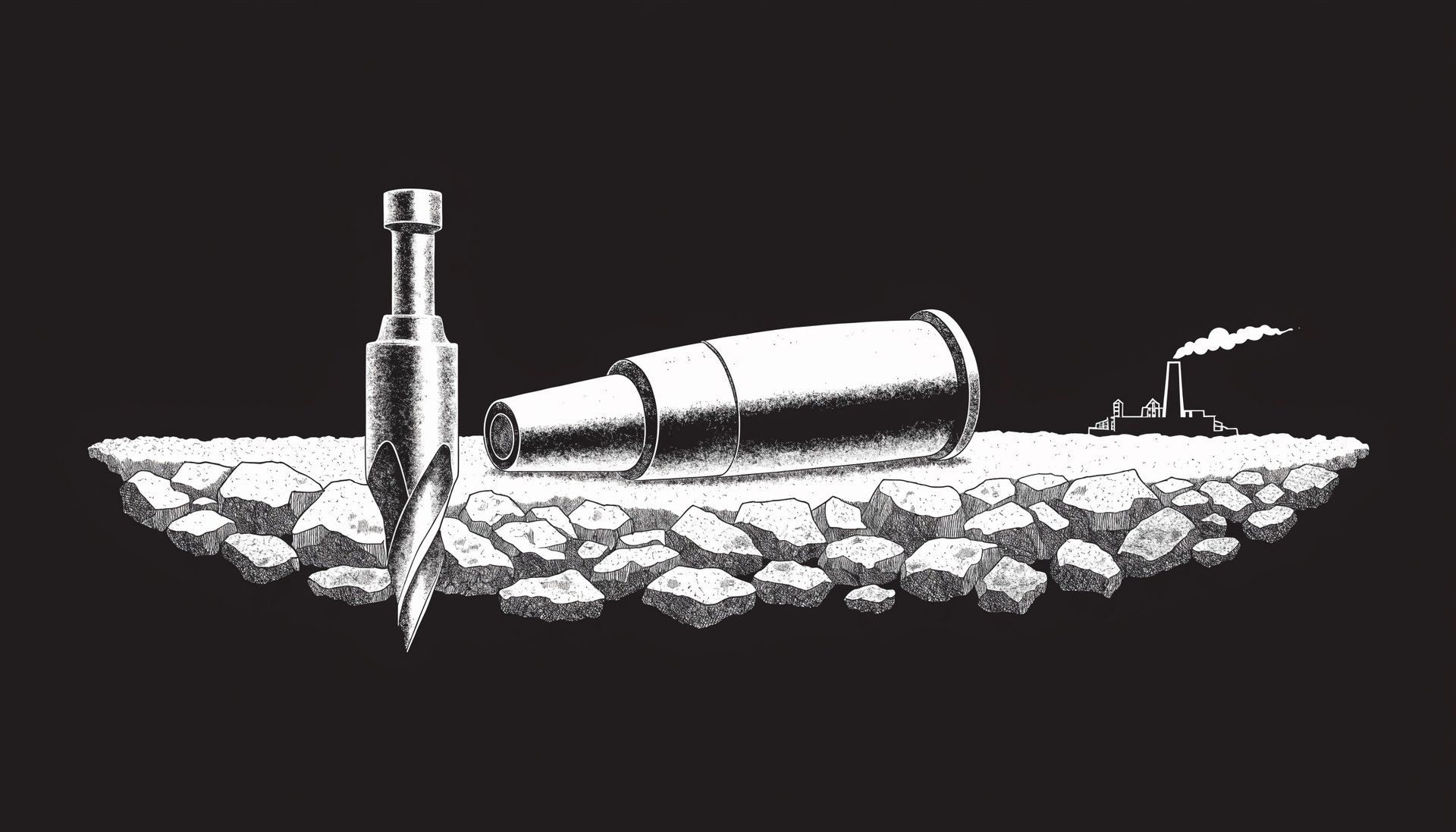
The second price is one you will not find on a retail screen or a television ticker. Tungsten, a dull grey metal most people have never knowingly held, has risen roughly tenfold since 2022. On the Rotterdam warehouse market, the traded form of the metal went from around USD 300 to above USD 3’000 for the same standard unit, which works out to something like USD 400’000 a tonne (Bloomberg’s David Fickling on Odd Lots, 3 August 2026; MINING.COM, 2026). It did this quietly, over three years, with none of the drama of an oil spike.
One of these prices is the war premium the whole market watches. The other is the war premium almost nobody watches. My argument is that the second one is the more honest of the two, and the more durable, and that it is telling us something the oil price no longer can.
What tungsten is, and why it costs ten times more
Start with the metal itself, because the properties explain the price.
Tungsten is the hardest and one of the densest metals in industrial use, and it has the highest melting point of any metal on earth. Those three facts make it irreplaceable in a specific and unglamorous list of jobs: the tips of drill bits and cutting tools, the parts of machines that must not deform under heat, and, above all, the business end of weapons. Armour-piercing rounds, shrapnel, and the guided missiles that define modern war all rely on it. A single JDAM-type guided bomb costs around USD 10 million and contains tungsten. There is no good substitute for most of these uses.
The market is tiny. The world consumes roughly 85’000 tonnes of tungsten a year, and most of that is recycled scrap from old tools and drill bits. For comparison, the world produces more copper than that before lunch. A market this small can be moved violently by a single decision from a single country.
That single country is China, which controls around 80 % of global tungsten supply. This is not only a policy choice; the geology genuinely favours China, and decades of Western effort have not changed it. The rest of the world, the United States, Europe, Japan, everyone, fights over the remaining 15 to 20 %. When China began restricting tungsten exports in 2025 and then confirmed that only fifteen companies would be licensed to ship the metal in 2026 and 2027, it handed Beijing direct control over how much leaves the country, when, and to whom. Buyers who suddenly could not count on Chinese supply started stockpiling ahead of tighter rules. A tiny market, a dominant seller pulling back, and a scramble of buyers: that is how you get a tenfold move.
The unit those prices are quoted in sounds technical but is simple. Traders price tungsten per “metric tonne unit”, which is just industry shorthand for 1 % of a tonne of contained metal. The same unit that fetched about USD 300 in 2022 now fetches above USD 3’000. Same metal, same measure, ten times the money.
A market that prices war
Here is the part that makes tungsten worth an essay rather than a footnote. For more than a century, investment in tungsten mining outside China has tracked the probability of war, and almost nothing else.
The pattern is remarkably clean. Western tungsten mines opened during the First World War, closed once it ended, reopened in 1938 as the next war approached, got a second wind from Korea, and shut again as the Cold War wound down. The reason is brutally simple economics. In peacetime, nobody can mine tungsten outside China at a profit, because China is cheaper and the market is too small to justify the risk. Capital only shows up when war looks likely enough that governments and investors will pay for supply security regardless of the unit cost. Tungsten investment, in other words, is a bet placed only by people who think a serious war is coming.
Right now a century-old mine in Tasmania is reopening. That is the signal. The numbers around it are almost comic: the whole project’s capital cost over twenty years is about USD 77 million, roughly what one of the world’s largest technology companies spends in an afternoon, and it could supply about 2.5 % of the global market. Cheap strategic insurance, ignored for decades, is suddenly being bought.
After the 1991 Gulf War, the West convinced itself that precision, chips, software, and air superiority had made old-fashioned attritional warfare obsolete. You would win with technology, not with vast stockpiles of shells. Ukraine has demolished that assumption. A grinding war of drones, artillery, and cruise missiles burns through exactly the tungsten-heavy munitions the West assumed it would never need again, and a potential conflict over Taiwan, where American technological overmatch is far from assured, points the same way. The doctrine has shifted back toward mass and attrition, and mass runs on metal.
So the tungsten price is best read as a market-based estimate of war probability, priced by the small group of people who have to put real money behind the answer. On that reading, they are pricing in more war, not less, and they are doing it in the same weeks that the oil market is pricing in peace.
Why the commodity index stays calm
If strategic metals are screaming, why does the broad commodity complex look so quiet? Because the thing that is moving is too narrow to show up in the index.
Across the whole commodity complex, the aggregate reading sits at just +0.09 sigma, measured across 31 indicators as of 1 August. In plain terms, the average commodity is sitting almost exactly on its own long-run normal. Inflation, by contrast, reads hot at +1.32 sigma on the same date, and global liquidity is expanding, with US money supply growing about 5.5 % year on year (FRED, June 2026). The backdrop is inflationary and awash with money, yet the broad basket of raw materials is unremarkable.
The action is hiding one level down, in a handful of strategic inputs that the index barely weights: tungsten, antimony, gallium, germanium, and the heavy rare earths. These are the metals that go into weapons, chips, and the machinery of a militarised economy, and they are precisely the ones China has been restricting. They are too small and too specialised to move a broad commodity index, which is exactly why the index can look calm while the metals that matter for national security go vertical.
The metals people do watch, copper up about 39 % over the past year, tin up about 58 %, silver up about 56 % (World Bank, July 2026), are riding a cyclical and electrification wave: data centres, grids, electric vehicles, the AI build-out. That is a growth-and-liquidity story, and it will ebb and flow with the cycle. The strategic-metals bid is a different animal. It is insurance against a fractured world, and it is driven by supply concentration and rearmament rather than by the strength of the next quarter’s economy.
The oil premium is built to fade
The oil move this week is a useful mirror, because it shows why an energy war premium tends to be temporary while a strategic-metals premium tends to stick.
An Iran conflict is best understood as a terms-of-trade shock rather than a recession trigger: it redistributes purchasing power from energy importers to energy exporters, priced through currencies and sector rotations, rather than crushing global demand. That framing carried a second implication that is playing out now. An oil premium is inherently mean-reverting, because the world has so many ways to relieve it. Producers reroute cargoes, strategic reserves get released, American shale keeps pumping at record levels, and buyers are patient because storage runs out in weeks. The instant diplomacy appears credible, all of that latent slack reasserts itself and the premium collapses. Brent below USD 80 is that collapse in real time.
A strategic-metals premium has none of those escape valves, at least not quickly. You cannot reroute your way around the fact that one country holds 80 % of supply. You cannot release a strategic reserve of a metal you never stockpiled. A new mine takes years, sometimes a decade, to move from decision to delivery, and in tungsten’s case there is not even a futures market to help finance it. A ceasefire in the Gulf does not add a single tonne of non-Chinese tungsten to the world. That is the difference in durability. Oil’s war premium can round-trip in a week, as it just did. The supply concentration behind tungsten does not resolve on a diplomatic headline.
The missing futures market deserves a moment, because it is the quiet reason peacetime capital never arrived. Copper has deep, liquid markets where a miner can lock in a future price and a bank will lend against it. Tungsten has nothing of the sort, so a would-be Western producer cannot hedge and cannot easily borrow, which means the only way durable supply gets built is with a government-backed floor price or a strategic reserve. The United States is now debating exactly that, a proposed USD 12 billion critical-minerals reserve nicknamed Project Vault. Whether that policy arrives is the catalyst that would turn a speculative squeeze into a lasting Western industry.
A debasement-and-rearmament read
The world is fragmenting into blocs that no longer trust each other’s supply chains, and governments are willing to pay up for control of critical inputs even when the economics look poor. When several countries simultaneously build their own parallel, non-Chinese supply chains for the same scarce metals, they are duplicating capacity that would never survive on cost alone. That redundancy is inflationary at the margin, and it is a deliberate feature of a rearming, deglobalising world, not a temporary glitch.
Tungsten is a small, vivid expression of the same force that has pushed gold up about 22 % over the past year (World Bank, July 2026) and kept central banks buying it. Gold is the deep, liquid anchor of this regime, and for a franc-based investor it remains the cleanest hedge, because it holds value when trust in paper claims erodes and it does not depend on any one government’s goodwill. The strategic metals are the satellite version of that trade: far smaller, far riskier, and far more direct as a bet on the rearmament story specifically. The liquidity backdrop matters here too. With money supply still expanding, there is fuel behind hard-asset bids of every kind, which is part of why a metal with an 85’000-tonne market can be pushed to ten times its price.
The honest risks
The first risk is a policy reversal. Most of tungsten’s move traces back to Chinese export controls. If Beijing eases those controls, whether as a trade concession or a negotiating gesture, the squeeze can unwind as fast as it built.
The second risk is that the world is a resourceful place under pressure. When supply gets squeezed, markets adapt in ways that eventually cap the price. Japan replaced lost Chinese supply with scrap and recycling after a 2010 cutoff. Carmakers engineered their way around a cobalt bottleneck by switching battery chemistry. Heavy rare earths, once thought to exist usefully only in southern China, are now being found in Brazil, Malaysia, Australia, and Africa as high prices fund the search. Substitution and rediscovery are slow, but they are real, and they are the natural enemy of any supply-driven mania.
The third risk is oversupply on the other side. If every country builds its own redundant mine and tensions then ease, there may be no buyer of last resort, and prices could collapse. History has a warning here: governments have repeatedly sold strategic reserves at the bottom, from the US helium reserve to the Bank of England dumping gold in the late 1990s.
What I am watching
The cleanest gauge to keep is the Rotterdam tungsten price itself, which now functions as a low-cost, real-time war-probability meter. When it stays elevated or climbs, the small group of people paid to be right about conflict is telling you they still expect it. The second thing to watch is policy: whether Project Vault and its European equivalents actually arrive, because a government floor price is what would convert a squeeze into a durable non-Chinese industry, and it would be a catalyst hiding in plain sight. The third is doctrine, the slow argument inside defence ministries over whether the next war is fought with precision or with mass, since that debate, more than any price, decides how much of this metal the world needs.
The larger question the tungsten move leaves open is the one worth sitting with. If the war premium has migrated out of the price everyone quotes and into a metal almost nobody does, then the oil market may be the last place to look for what a fracturing world costs. The more useful exercise is to ask which other strategic inputs are being repriced right now, quietly, while the broad index sits calmly on its long-run average and reassures everyone that nothing much is happening.
Be the first to read our upcoming papers.
Some articles are reserved. Leave your email to unlock access to upcoming Meotis Research publications.
Share