








Compute as an asset class: the physical-bottleneck trade comes to Switzerland
The binding constraint on AI has moved from software to megawatts, memory and fabs. Once the scarce thing is physical, it can be owned directly, and a small river valley shows what that looks like for a Swiss investor.
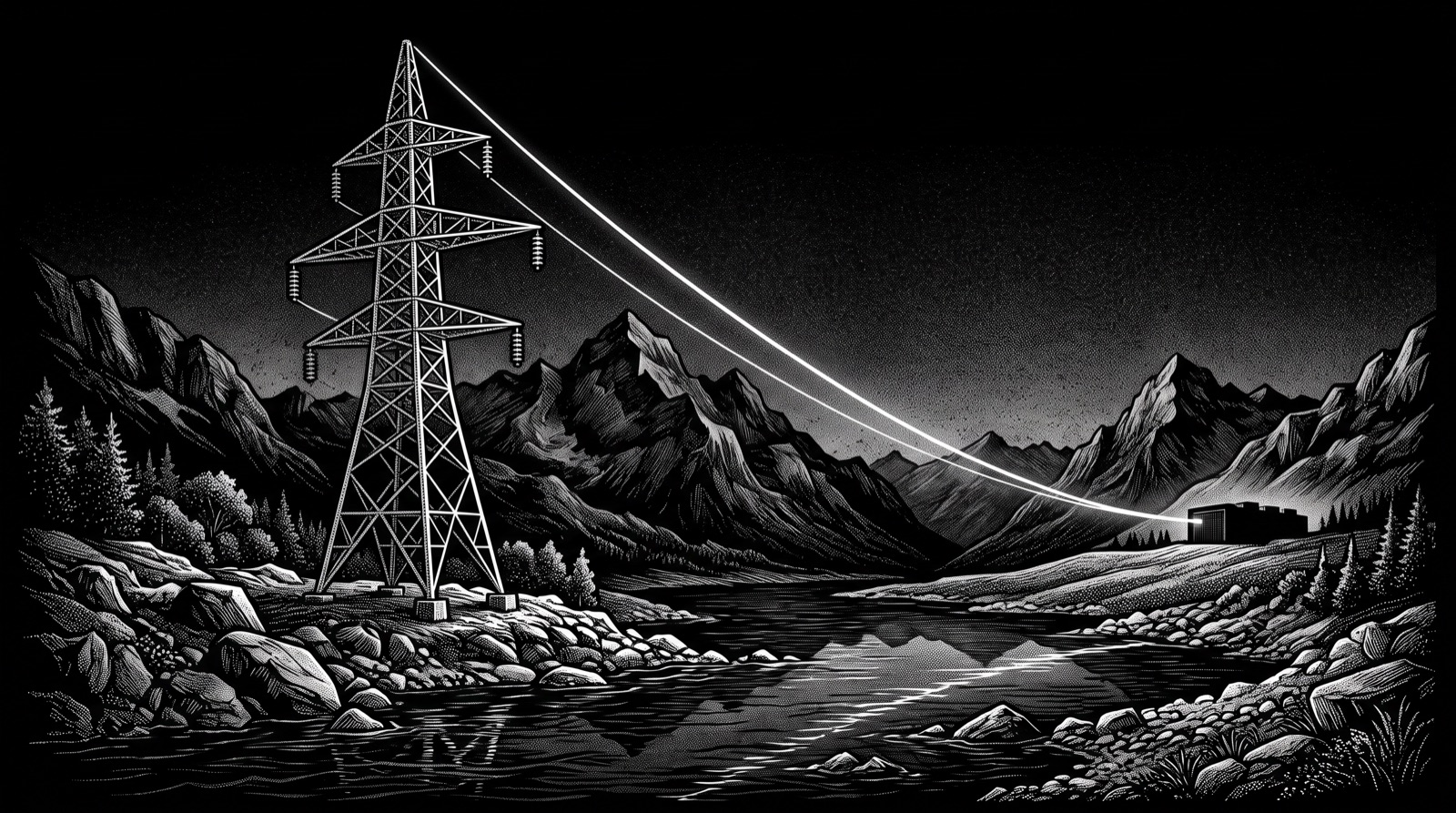
For two years the argument about artificial intelligence was an argument about models. Whose model scored higher, whose was cheaper to run, whose would plateau first. That argument is mostly settled, and it turned out to be the easy part. The hard part is physical. A model needs a building, a cooling system, a fibre link and, above all, electricity delivered to a specific plot of land at a specific voltage. Those things are now the scarce inputs. And scarce physical things can be owned.
That is the whole of this piece. The binding constraint on AI has moved from software to megawatts, memory and fabs. Once the scarce thing is physical, it stops being only a story you buy through shares and becomes a story you can underwrite directly, the way an investor underwrites a warehouse, a toll road or a power station. I want to lay out where the constraint actually sits today, what the scarcity is worth, why owning the asset behaves differently from owning the proxy, and how a small Swiss river valley turns all of this into something a Swiss investor can touch. I hold parts of this as high conviction and parts as a hypothesis to test, and I will say which is which as I go.
A note on where I am writing from. The house macro read is a restrictive one: the US policy rate sits at 3.63% with inflation still running above target, so real rates (the rate after inflation) are only marginally positive at about +0.17%. Money supply is still growing at roughly 5.6% a year, and government spending is doing a lot of the work holding the economy up. That mix, positive-but-tight rates, sticky inflation and fiscal dominance, is historically kind to real assets that throw off contracted income and unkind to expensive claims on far-future profits. Compute infrastructure, done properly, is the former dressed as the latter.
The constraint moved to the grid
Start with the number that reframes everything. Global electricity use by data centres was roughly 485 terawatt-hours in 2025 and is set to about double, to near 950 terawatt-hours, by 2030 on the International Energy Agency’s central path. A terawatt-hour is a billion kilowatt-hours; the doubling alone is more new electricity demand than most countries consume in total. In the United States, data centres account for about half of all projected growth in electricity demand this decade.
The chips were supposed to be the wall. They are no longer the wall. The wall is getting power to the site. In the largest US grid region, PJM, a new generator waits around 40 months to connect, and a candidate data-centre site sits in a queue that runs three to four years. In Texas, the interconnection queue for large loads went from about 63 gigawatts at the end of 2024 to over 400 gigawatts by April 2026, most of it data centres (a lot of that is speculative and duplicated, so treat it as a signal of intent, not firm demand). And where the grid cannot cope, the state simply says no: New York signed a statewide pause on new hyperscale data centres above 50 megawatts in July 2026, Dublin is taking no new connections until around 2028, and Amsterdam has pushed new applications out to 2035.
The word that matters here is rationing. When a resource is rationed by a queue and a permit rather than by price alone, whoever already holds a connected, powered, permitted site holds something close to a licence. That is the migration in one sentence: what gets rationed now is the electron arriving at the rack.
What the scarcity is worth
Scarcity you cannot price is just a headline. This one prices cleanly, and in several places at once.
Firm round-the-clock clean power now trades at a visible premium. The nuclear deals tell the story: Microsoft is paying to restart the Three Mile Island reactor under a 20-year contract, and Amazon signed a roughly USD 18 billion arrangement with Talen for up to 1’920 megawatts of nuclear output. Disclosed terms are thin, but analyst estimates put these contracts near or above USD 100 per megawatt-hour, roughly twice the wholesale power price. That gap is the scarcity premium on power that runs every hour of every day, which is exactly what an AI cluster needs.
The premium shows up in the auctions too. PJM’s capacity auction, which pays generators to promise power will be there when needed, cleared at USD 28.92 per megawatt-day for 2024/25 and at USD 329.17 for 2026/27. That is more than eleven times higher in two years, and the grid’s own monitor attributes most of the jump to data-centre load.
Then there is the equipment to build any of this. The three firms that make most of the world’s large gas turbines are effectively sold out to the end of the decade, with GE Vernova alone carrying an 80-gigawatt backlog. Large transformers, the boxes that step voltage up and down between the grid and the site, now carry lead times beyond three years. US regulated utilities plan a record USD 1.3 to 1.4 trillion of investment across 2026 to 2030 to serve this load. Every one of those numbers is a firm booking pricing power without much commodity risk.
Two more bottlenecks sit further up the stack. The first is memory. The specialised high-bandwidth memory that AI chips need is sold out for 2026 and booked into 2027 and 2028, its price carries a premium above 30% for each new generation, and the crowding-out has pushed ordinary computer-memory prices up roughly 90% in a single quarter. The company that dominates this memory, SK Hynix, is running operating margins around 72%, richer than the chip designer it supplies. The second is optics. Past about one metre, copper wire can no longer carry the signal between AI chips, so the connections move to laser light over fibre, and that optical market is growing about 60% this year.
One episode is worth holding onto, because it is the discipline of the whole trade in miniature. In mid-July 2026 SK Hynix, the seller of the single scarcest input, fell more than 15% in one session, its worst on record, and dragged the Korean market down 9%. Scarcity had not eased. The problem was that roughly half its revenue sits under fixed-price long contracts, so when the spot price exploded, the company could not capture it fast enough. Owning the scarce thing is only half the job. How you contract the cashflow is the other half, and it decides whether you keep the rent or watch it accrue to someone else.
Own the asset or buy the proxy
Here is where the phrase in the title earns its keep. If compute infrastructure is now a real asset like a power station or a warehouse, then an investor faces the same choice they face with property: buy the building, or buy shares in a company that owns buildings.
The two routes are priced very differently right now. Listed proxies for this theme, the big cloud owners and the data-centre landlords, trade at something like five to eleven times book value. Book value is roughly what the assets cost to build; paying eleven times it means paying eleven francs for one franc of physical plant, on the expectation that the rent grows fast enough to justify it. Direct ownership of the same physical plant costs about one times book, because you are buying the concrete, the transformers and the cooling at construction cost. Same underlying scarcity, wildly different entry price.
I do not want to oversell the gap. The listed names are liquid, diversified and professionally run, and part of their premium is deserved. But two things make me cautious about paying it in this particular cycle. The first is that the financing under the listed AI complex has turned circular: a chipmaker invests in a model lab, the lab signs a giant compute contract with a cloud provider, the cloud provider buys the chips, and much of it is increasingly funded with debt. While demand rises, that loop reads as a virtuous circle. The day it stalls, it reads as vendor financing.
The second is the liquidity backdrop, and this is where the house Howell framework matters. Michael Howell’s lens treats global liquidity as the primary driver of markets, and its central fact is that around three-quarters of financial-market activity today is simply refinancing old debt rather than funding new investment. The system has become a giant rollover machine, and a large wall of pandemic-era borrowing comes due for refinancing through the back half of this decade. In that regime, the more leveraged and the more richly valued a claim is, the more it depends on liquidity staying easy at the exact moment it needs to roll. A real asset held at construction cost, with income contracted years ahead, is a far calmer thing to own into a refinancing squeeze than an eleven-times-book proxy funded on a circular loop. That is a high-conviction view.
A valley’s fourth industry
All of this stays abstract until it has an address. There is a candidate one, and it is in Switzerland. Our research has been studying a site on a short Swiss river, whose location we are not disclosing until something is signed, as a concrete way to own the scarce layer directly. I present it here as a worked example of the thesis, not as a finished plan; it is under study, and nothing about it is committed.
The site tells its own story. It is a short stretch of river with a steep drop, fed by a permanent karst spring that delivers water at a steady 8 to 10 degrees, cold enough to cool machines for free. Its industrial history reads like a timeline of Swiss enterprise: medieval mills, dozens of waterwheels through the nineteenth century, manufacturing works, then a fully renovated hydroelectric plant that still produces power today. From waterwheel to turbine to GPU rack, the same cubic metre of water would be put to its fourth industry.
The model has three layers, and the point of it is to own the two that are durable and rent out the one that is not.
The base layer is energy and land: the plot in the valley, the electrical connection, and the right to use the river water, secured alongside the existing hydro operator as a partner rather than a rival. The local grid is already about three-quarters renewable, and the utility cut professional electricity tariffs for 2026, so the input is clean, local and getting cheaper. The middle layer is a modest 2-megawatt modular data centre, cooled by river water rather than by energy-hungry chillers. The measure here is PUE, power usage effectiveness, the ratio of total power drawn to the power that actually reaches the computers; a typical site runs around 1.5, and free river cooling targets about 1.1, which is roughly 30% less electricity wasted. The top layer is revenue: a long lease to institutions that need their data and their AI models to stay under Swiss law, plus a second income stream from selling the waste heat into a nearby district-heating network, into which the regional utility is investing hundreds of millions over ten years. The heat becomes a revenue line instead of a disposal problem.
The economics, at order-of-magnitude only, look like this for a first 2-megawatt phase: roughly CHF 18 to 24 million to build the shell and its systems, colocation rent of around CHF 3 to 5 million a year (colocation simply means renting powered, cooled, secured space to a tenant who brings their own machines), and up to about CHF 0.4 million a year from the heat. The lease structure that makes it investable is a long one, 10 to 20 years, triple-net and take-or-pay, meaning the tenant pays the rent whether or not they actually use the capacity, and covers the running costs on top.
And here is the single most important discipline in the whole design. The price to rent a GPU by the hour, the merchant compute price, has already fallen 64% to 75% from its peak. That merchant hour is deflationary and belongs to the tenant. The durable asset is the powered, cooled, permitted shell underneath it, let on a long contract. You own the building and the connection, which amortise over 25 to 40 years. You leave the fast-obsolescing silicon, and the price war over compute-by-the-hour, to whoever signs the lease.
Why Switzerland fits the trade
The Swiss framing is load-bearing. Most of the world’s grid constraint is structural: America, Ireland and the Netherlands are short of power and permits for years. Switzerland’s constraint is seasonal, a winter import gap of a few terawatt-hours, and there is no Swiss moratorium on data centres of the kind New York just imposed. That is a meaningful relative advantage for building here rather than queuing there.
The currency lens reinforces it. A long lease priced and paid in francs, on an asset sitting on Swiss soil, is a franc-denominated real income stream, which is exactly the kind of cashflow a CHF-based investor wants when the dollar is strong and safe-haven flows keep the franc bid. It also answers a demand that is only growing: European and Swiss institutions increasingly want their data and their model weights to stay under home jurisdiction rather than depend on US frontier labs. In this context, sovereignty is a paying tenant.
None of this requires believing AI will change the world. It requires believing that the people trying to build AI will keep needing power, cooling and floor space in a jurisdiction they trust, and will pay a long contracted rent to get it. That is a lower bar, and a sturdier one.
Where this breaks
I would rather state the ways this fails than have a reader find them.
The most consequential risk is the one the whole house view turns on: a genuine slowdown in hyperscaler capex intent. If the firms building AI pull back, delay orders and pivot from expanding capacity to defending margins, the demand under every layer in this piece softens at once. I watch that as the single exit signal, and it has not flashed, though reports that a meaningful share of planned US data-centre builds are being delayed are the first data point that could become it. The defence built into the structure of the site is precisely the long take-or-pay lease signed before construction: the point is to contract the cashflow up front, so a later cooling in the merchant market lands on the tenant, not the owner. I hold this as the risk to watch above all others.
The site-specific risks are real and more mundane. A severe dry year would pull the river low enough to constrain cooling; the mitigation is the lake as a backup outlet and prioritising the heat sale, which reduces what gets returned to the river. If the watercourse is classified as a trout habitat, the permitted thermal load could roughly halve, which is a genuine diligence gap to close before anyone commits. Cantonal water concessions and permits take time. And technology risk, the fear that a data centre is obsolete in a few years, sits with the tenant’s chips in this structure, not with the owner’s building, cooling and connection.
Then the category that always arrives from somewhere unmodelled. An infrastructure return in the double digits carries a matching risk of real capital loss, and anyone who forgets that has misread the asset. This is a proposal to study a hard, illiquid, single-site project with a long build. I would size it as a satellite real-asset sleeve for patient capital, not as a core holding, and I hold the return case as a hypothesis to be proven by an engineering study, not as a forecast.
What I am watching next
The cleanest gauges of whether this trade is early or late are already public, and none of them is an earnings call. Watch the spot price to rent a GPU by the hour, which tells you whether compute is getting scarcer or cheaper. Watch Korea’s monthly semiconductor export figures, the fastest read on whether the memory cycle is still accelerating. Watch the capacity-auction and interconnection-queue data, which price the power bottleneck in real time. And watch, above all, any sign that the hyperscalers are pulling their capex plans.
The larger question this case opens is a Swiss one. A century ago this country turned its rivers into a competitive advantage by owning the water rights and building the turbines, and it is still living off that decision. The same valley now offers the same choice in a new industry: treat connected, permitted, cooled compute capacity as the next hydro concession and own it, or rent the exposure back at eleven times its cost from someone who did. I know which of those a Swiss investor was historically built to do. The interesting part is finding out whether we still are.
This is markets research and commentary written for a broad general readership. It is not personalised investment advice. Figures attributed to external sources (IEA, PJM, CBRE, JLL, company disclosures and the research cited in our notes) are theirs, not house guarantees, and several project economics are order-of-magnitude estimates pending engineering study.
Be the first to read our upcoming papers.
Some articles are reserved. Leave your email to unlock access to upcoming Meotis Research publications.
Share