








Running an LLM on a blockchain: our first paper measures the true price of every token
On-chain inference under instruction budgets: a cost model, ternary floor evidence, and session costs, measured on the Internet Computer
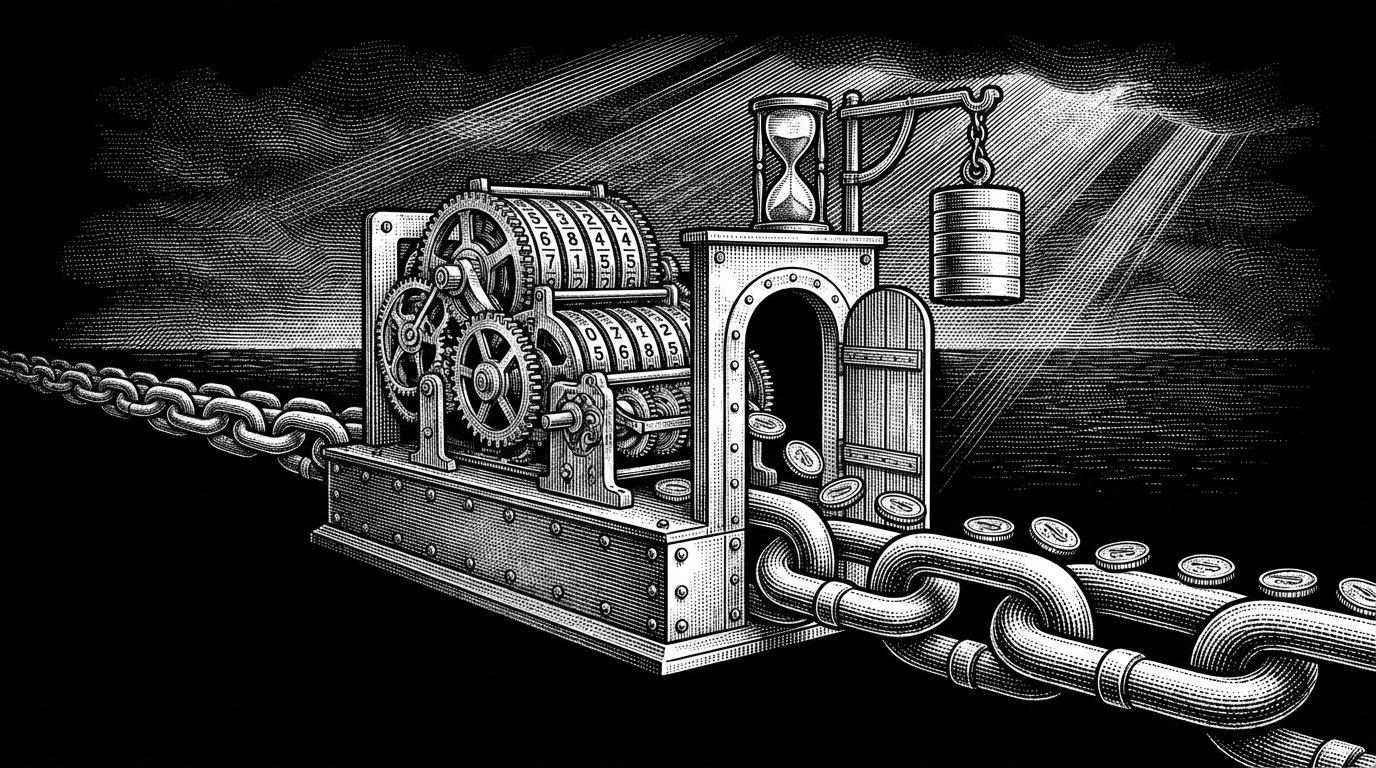
In a few words. Running an AI directly on a blockchain means paying for every computation in individually counted “instructions,” not in server seconds. Our paper measures precisely what each token generated by a language model costs on the Internet Computer (ICP), and shows three things: the cost depends first on the quality of the software running the model, it can be predicted with a simple formula from the model’s spec sheet, and there is a measurable floor that a purpose-built ternary weight format reaches. All of it with bit-identical outputs from one network to another: the very definition of verifiable AI.
What the paper shows
Three main results, all measured on the real ICP network, not in simulation:
- Software sets the price. The same model, on the same canister, generates 10 tokens per call with the community implementation and 29 with ours. Nearly triple, without changing the model or the hardware: the cost coefficient is a property of the execution software.
- Cost is predictable from the model card. Across 11 recent models from 8 families, a simple law links the instruction budget to the number of generated tokens, with a mean error of 7.7%. Matrix multiplication accounts for roughly 98.7% of the cost: it is the one thing worth optimizing.
- A ternary floor, verifiable to the bit. An execution path purpose-built for ternary weights reaches the empirical floor of decode cost, with byte-identical outputs across a local replica, a 13-replica Swiss subnet, and ICP mainnet.
Why it matters for Meotis
Our thesis is that an organization’s cognitive heritage must be sovereign and verifiable. We already practice on-chain anchoring with LAMS and the ORIGYN Foundation on ICP. This paper explores the next step: not just proving the integrity of data on-chain, but executing the intelligence itself in an environment where every computation is counted, reproducible, and audited by consensus. An AI whose every answer can be verified to the bit by independent machines is the strictest version of “nothing happens without a trace.”
The paper is authored by Julien Aerni, Siméon Fluck, and Dustin Becker, published in open access (CC BY 4.0). Every number in the paper traces back to a named measurement file, and the headline result reproduces in about thirty minutes with the companion artifact.
Read the full paper and reproduce every number. The PDF, measurement registry, raw on-chain logs, and reproduction procedure are published in open access on Zenodo.
View the paper on ZenodoBe the first to read our upcoming papers.
Some articles are reserved. Leave your email to unlock access to upcoming Meotis Research publications.
Share