


Comoto OS: the AI that knows your entire company and executes the work, hosted on your premises
An assistant that knows your organization, keeps your data at home, shows its evidence, and always leaves you the final word. A guided tour, jargon-free.

Most artificial intelligence assistants all work the same way: your documents, your contacts, and your notes travel up to the servers of a cloud giant, which does its thinking there and sends the answer back. It is powerful, and that is precisely the problem. Comoto OS takes the opposite path: the intelligence moves in with you, and nothing leaves without a rule written in code.
Your data stays at home
Picture an office filing cabinet: everything your organization knows, from notes and contacts to projects and decisions, stored in folders you can open yourself. That is exactly how Comoto OS stores your company memory: ordinary files, readable on your own machine, even without the application. If you stop everything tomorrow, you keep everything. No export to request, no locked-in format.
This choice has two very concrete consequences. First, Comoto OS works without internet: on the train, in the mountains, during an outage, your company brain stays open. Second, it responds fast. Very fast:
| Typical response time | |
|---|---|
| Comoto OS, installed on your premises | 6 to 20 thousandths of a second |
| Major cloud services (the network round trip alone) | 180 to 270 thousandths of a second |
Measurements taken on May 6, 2026 from a workstation in Switzerland, on a Comoto OS reference installation and against the interfaces of the leading cloud providers. The cloud figure counts only the network journey, before their AI even starts thinking.
In other words: access to your local memory is instant, with no network round trip. Opening your calendar, finding a contact, searching your documents, checking off a task: these everyday actions depend on no remote server. Requests that call on a major market model remain, of course, dependent on that model.
You speak. It handles the work. You approve.
Comoto OS is used first and foremost by voice, the way you would speak to a colleague: “What’s on my plate today?”, “Prepare the client file for me”, “Remind me what we decided in March”. Behind the scenes, a fleet of agents, specialized assistants, does the work: searching, drafting, filing, preparing.
But unlike assistants that charge ahead, Comoto OS follows one simple rule: nothing important happens without your approval. Before acting, the agent presents its plan: you approve it, correct it, or reject it. And at the end, it does not just say “done”:
An assistant that says “done” without showing anything is a promise. Comoto OS presents the receipt.
Every completed job arrives with its evidence: what was produced, verified, and modified. And it is the system that validates completion, never the agent itself. To our knowledge, no mainstream assistant works this way today. For an organization, that is the difference between delegating and hoping.
What it looks like
On iPhone, the home screen is your arrival into the day: a greeting, the weather report for your work, what is overdue and what is scheduled today, and your team within thumb’s reach.
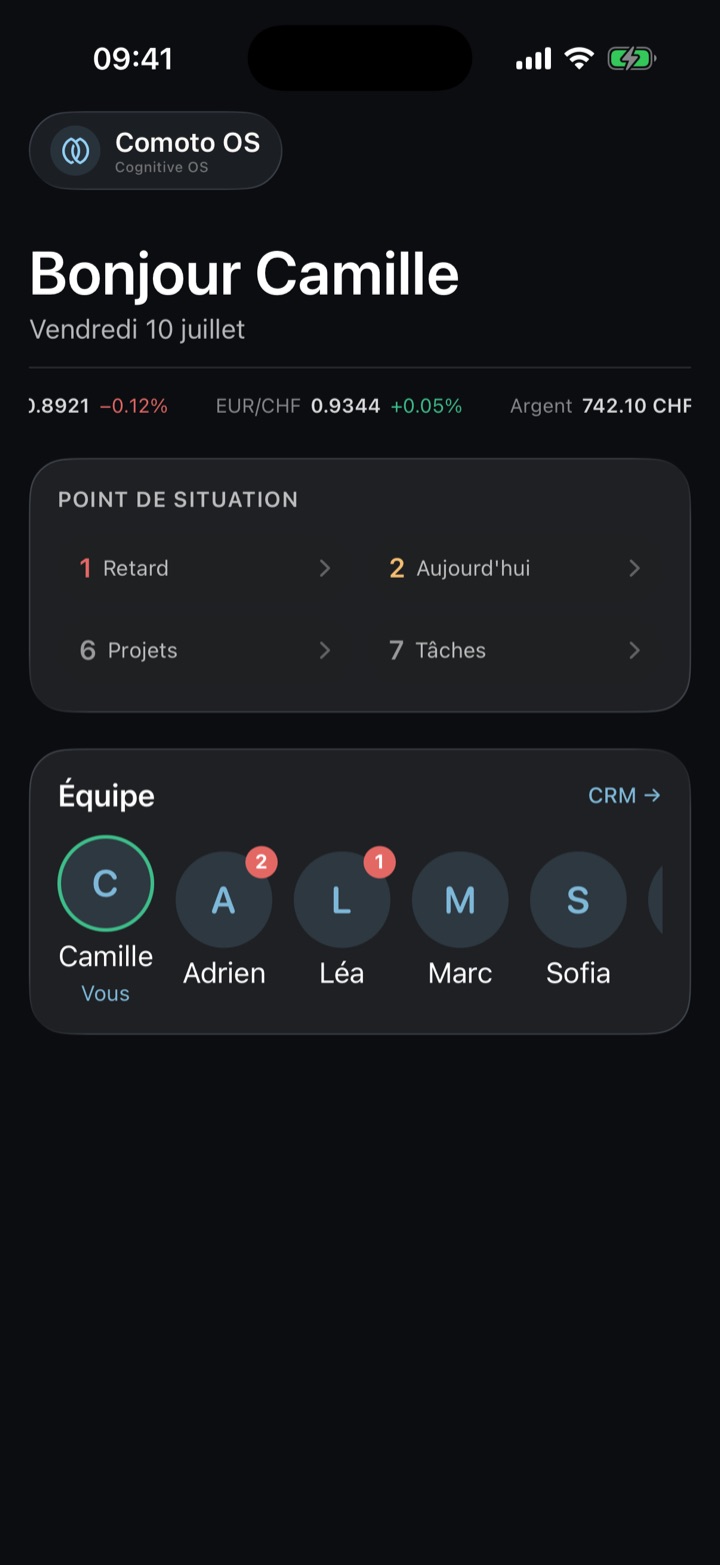
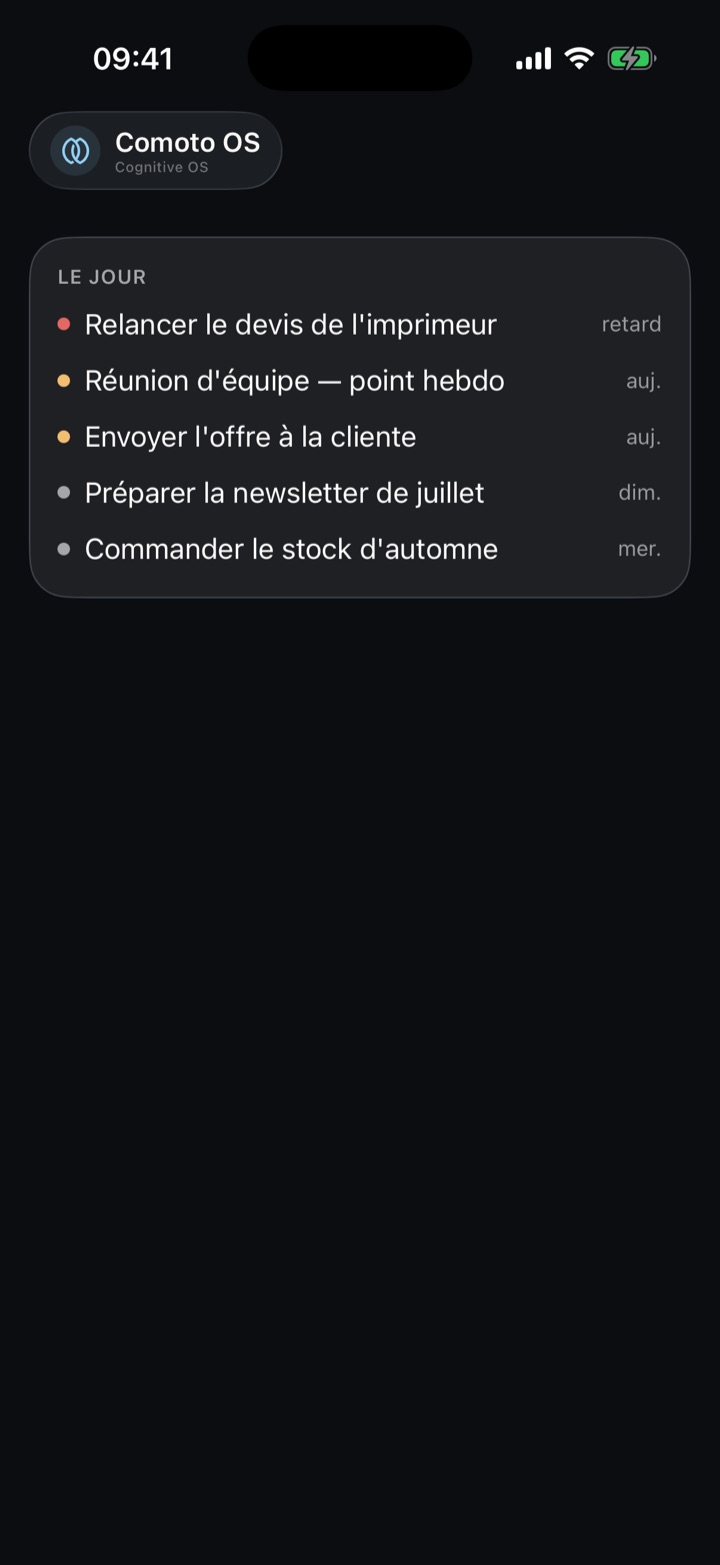
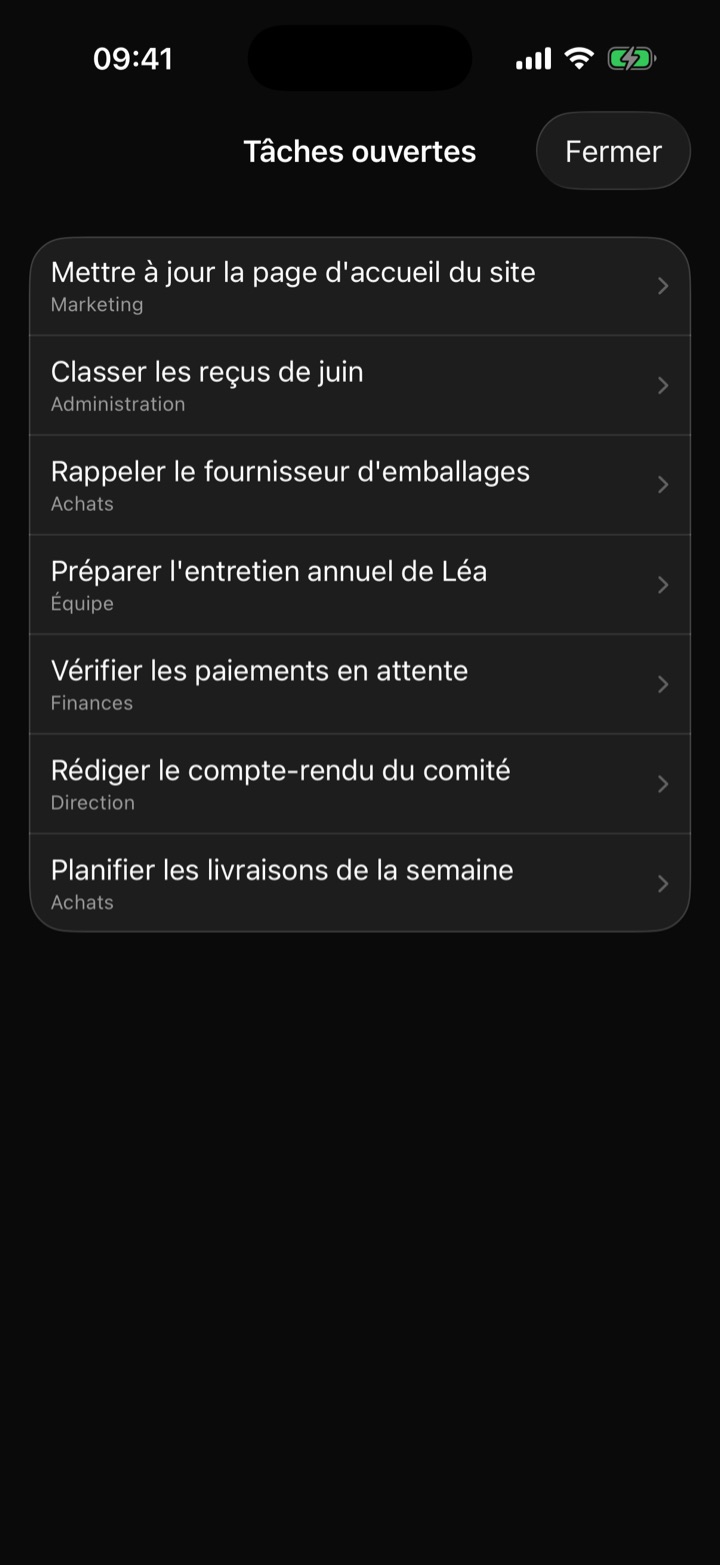
Screenshots in demo mode: names, figures, and deadlines are fictitious.
On Mac, the same brain takes the form of a command post: dashboards, projects, review of the agents’ work, always plugged into your own data, never simulated data.
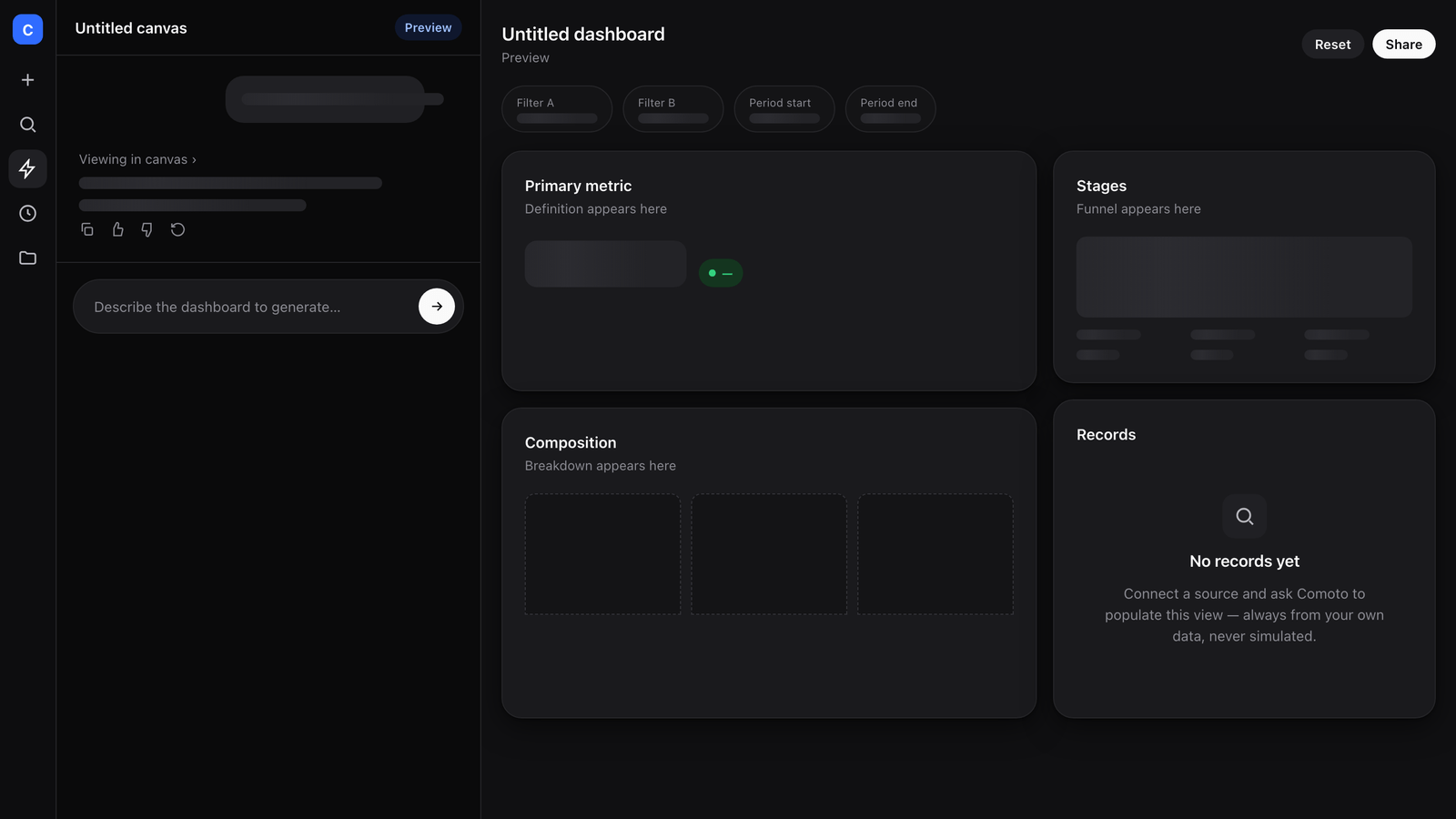
The Mac interface: describe the dashboard you want and Comoto builds it, from your data, never invented data.
One last detail that matters: every organization receives an application in its own name, with its logo, its colors, its scope. Not an account with a third party: your system.
And how much does it cost?
The assistants on the market are paid for per person, per month, indefinitely. Public prices as of May 10, 2026:
| Offering | Price per person / month |
|---|---|
| Microsoft 365 Copilot | $30 (on top of the existing Microsoft license) |
| Claude Team (Anthropic) | $25 to $30 |
| ChatGPT Business (OpenAI) | $20 to $25 |
| Notion Business (AI included) | $20 to $24 |
| Glean (enterprise search) | quote-based · typically $40 to $75+ |
Sources: official pricing pages and specialized analyses, consulted on May 10, 2026.
For a 50-person organization, $30 per person per month means $18,000 flying away every year, and it will keep flying away year after year. Comoto OS follows a different logic: one license per organization, no per-person meter. Adding a team member costs nothing; the intelligence can run on your machines, and when you do call on the market’s large models, every cent is tracked.
Who is it for?
Comoto OS is designed for those whose data must never leak: companies and institutions on one side, private wealth and families on the other. The same sovereign core, two worlds. Designed and operated from Neuchâtel, Switzerland, because sovereignty is not a marketing argument, it is an address.
The essentials in three sentences
- Your data stays with you, in readable files that belong to you, with or without internet, with or without us.
- You speak, it handles the work, you approve: every important action goes through your approval, and every completed job arrives with its evidence.
- One license per organization, an application in your name, not a per-seat subscription that grows with your team.
Your company's brain. On your premises, not a third party's. Discover how Comoto OS indexes your cognitive heritage, locally, and puts a fleet of agents under your control.
Discover Comoto OSBe the first to read our upcoming papers.
Some articles are reserved. Leave your email to unlock access to upcoming Meotis Research publications.
Share